Expanding your Spanish vocabulary is not about collecting translations, but about remembering what a word means, which other words it commonly appears with, and how to use it in a sentence of your own. A translation can be a useful clue, but context and active recall help make the word available when you speak or write.
Save words that go together
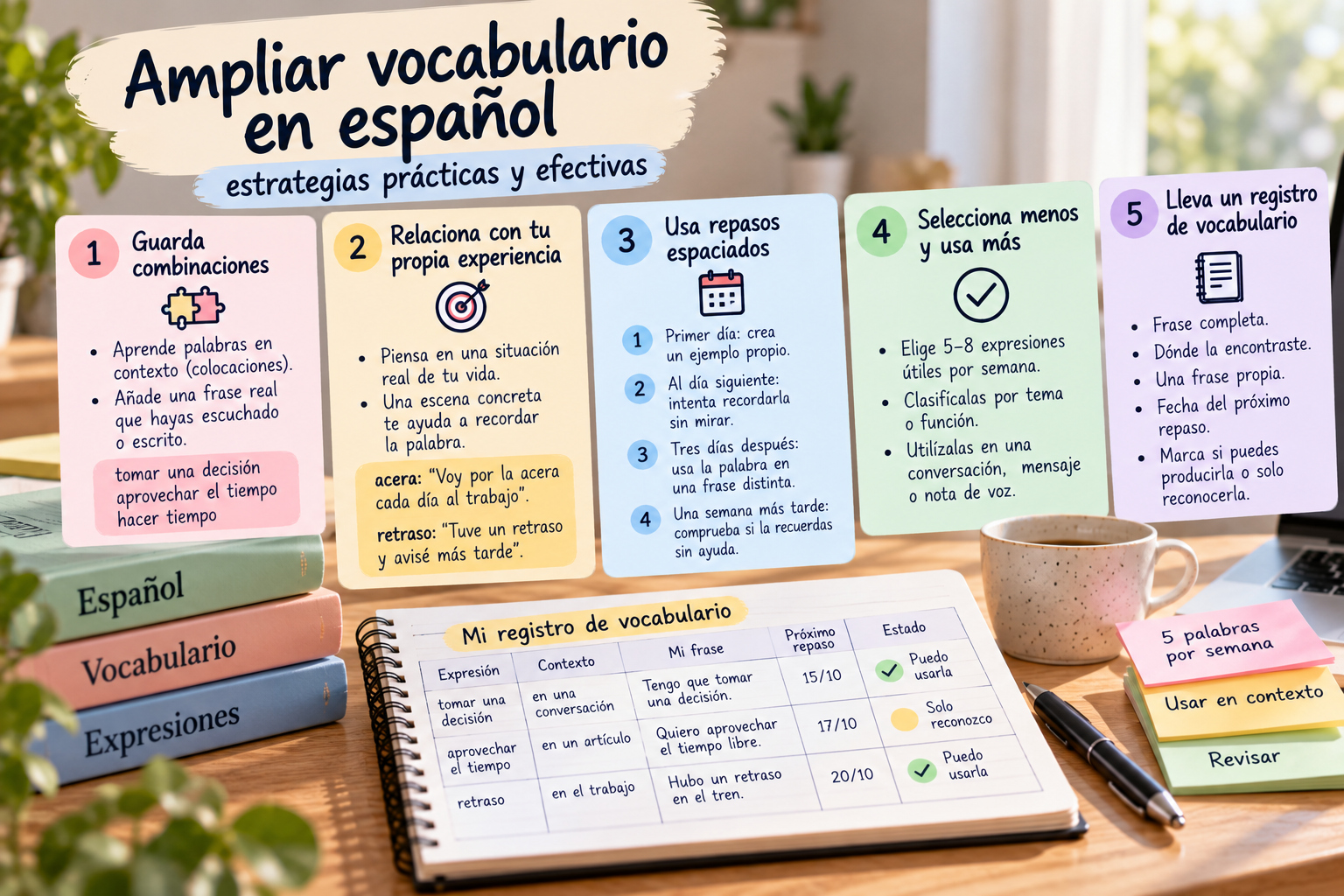
Rather than writing down only decisión (decision), record tomar una decisión (make a decision); for tiempo (time), try aprovechar el tiempo (make good use of time) or hacer tiempo (kill time). These combinations are called collocations and let you learn a verb and noun together. Add a real sentence you have heard or written.
Connect each word with a personal context
To learn acera (pavement), write a sentence about your daily route. For retraso (delay), recall a time when you had to say you would be late. A specific scene provides more memory cues than an alphabetical list.
Use spaced reviews and recall without looking
- On day one, read the word and make up your own example.
- The next day, cover your notes and try to remember it.
- Three days later, use it again in a different sentence.
- A week later, check whether you can recall it unaided.
If you cannot remember a word, check the answer and try again later. Forgetting shows which material needs another review; it does not mean the method has failed.
Choose fewer expressions and use them more
Choose five to eight useful expressions per week. Group them by topic or function—requesting, describing, disagreeing—and use them in a message, voice note or conversation. Mark which ones you can already produce and which you only recognise when reading; both abilities matter, but require different kinds of practice.
Keep a vocabulary log you can revisit
For each expression, record four things: the complete phrase, where you found it, a sentence of your own and the date of your next review. Add a mark to distinguish expressions you can produce from those you only recognise. Each week, remove or archive words you already use easily and spend more time on those you still forget. A small log that you actually review is more useful than hundreds of flashcards you never open again.
Reading, listening and conversation offer contexts in which to discover new words and use them again. Practise with our online Spanish courses.