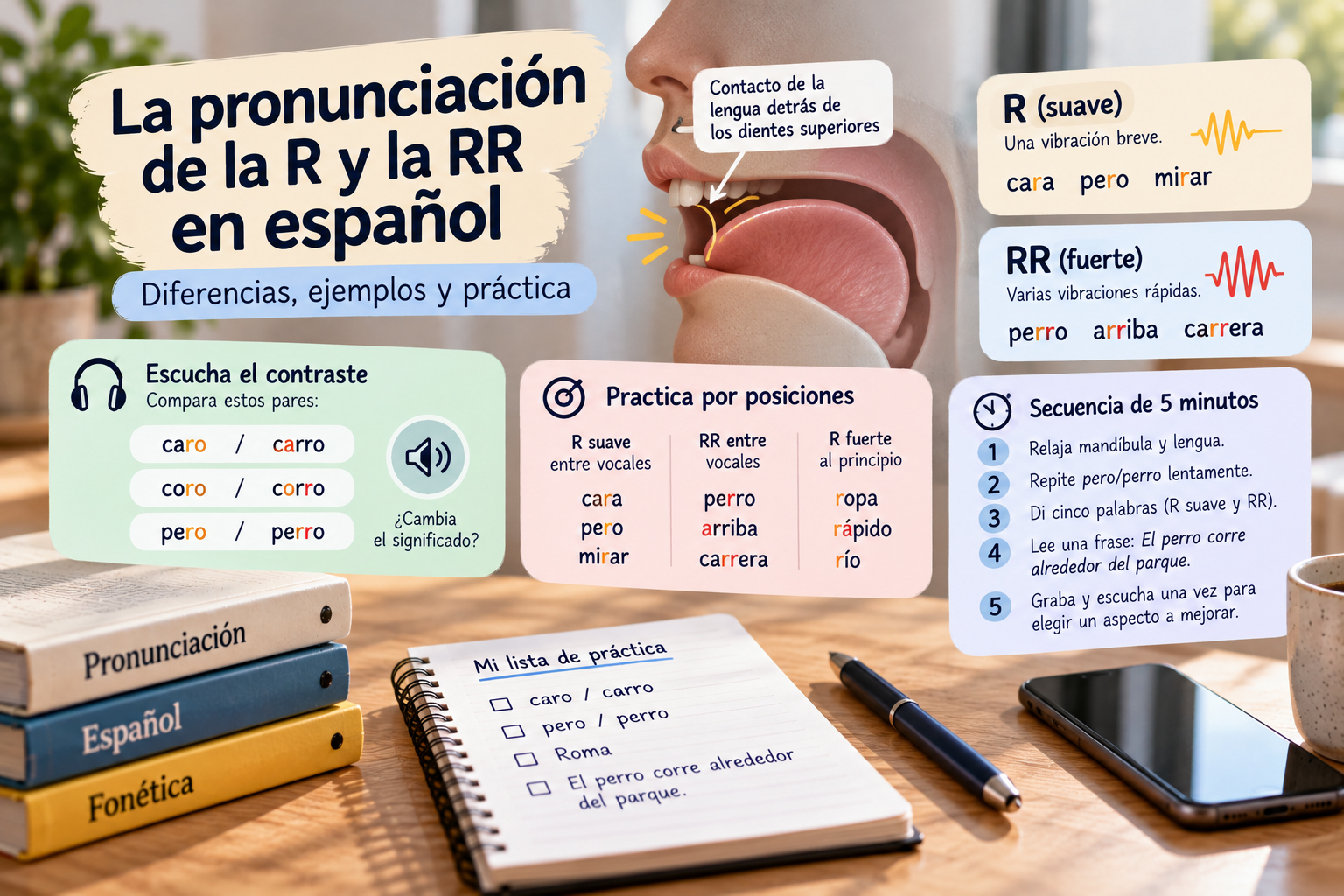
Pronouncing the Spanish R and RR distinguishes words such as pero (but) and perro (dog). The single-tap r usually involves a quick touch of the tip of the tongue just behind the upper teeth; the trilled rr involves several rapid contacts. There is no need to clench your jaw or push hard: too much tension often makes the movement harder.
Hear the difference before trying to make it
Compare pairs such as caro/carro, coro/corro and pero/perro. Listen for the change in meaning, and identify which word has one short tap and which has a trill. Then say each pair within a sentence so you practise the contrast in context.
Practise in different word positions
- Single-tap R between vowels: cara, pero, mirar.
- RR between vowels: perro, arriba, carrera.
- Strong R at the start of a word: ropa, rápido, río.
The letter r also represents a strong sound at the beginning of a word and after certain consonants. Listen to pronunciation models, because spelling alone does not always tell you every detail.
A five-minute practice sequence
- Relax your jaw and tongue; breathe without straining.
- Slowly repeat the pero/perro contrast three times.
- Say five words from one category, first with a single-tap r and then with a strong r.
- Read a sentence: El perro corre alrededor del parque (The dog runs around the park).
- Record yourself and listen once to choose one aspect to improve.
What to do if you cannot produce the trill
Slow down, return to simpler words and practise in short sessions. Learning the trill can take time, and not everyone develops it through the same exercise. Stop if you feel pain or tension. A teacher can observe your articulation and suggest a suitable progression. The priority when speaking is being understood, not eliminating your accent.
How to decide what to practise next
Read a short list containing caro, carro, pero, perro, Roma and make a natural recording without exaggerating the trill. Listen for whether the contrast between word pairs is clear and whether the sentence can be understood at normal speed. Note one difficult word and practise just that word for a minute before returning to the sentence. If the problem only appears when you speak quickly, first aim for accuracy at a comfortable pace, then gradually increase speed.
For individual feedback on pronunciation, explore our private Spanish courses.