Practising spoken Spanish every week works better when you have a purpose for each meeting and a simple way to review what you learn. You do not need to talk for hours: a short, repeatable routine can help you expand your vocabulary, respond more fluently and identify the topics you want to work on.
A three-session routine
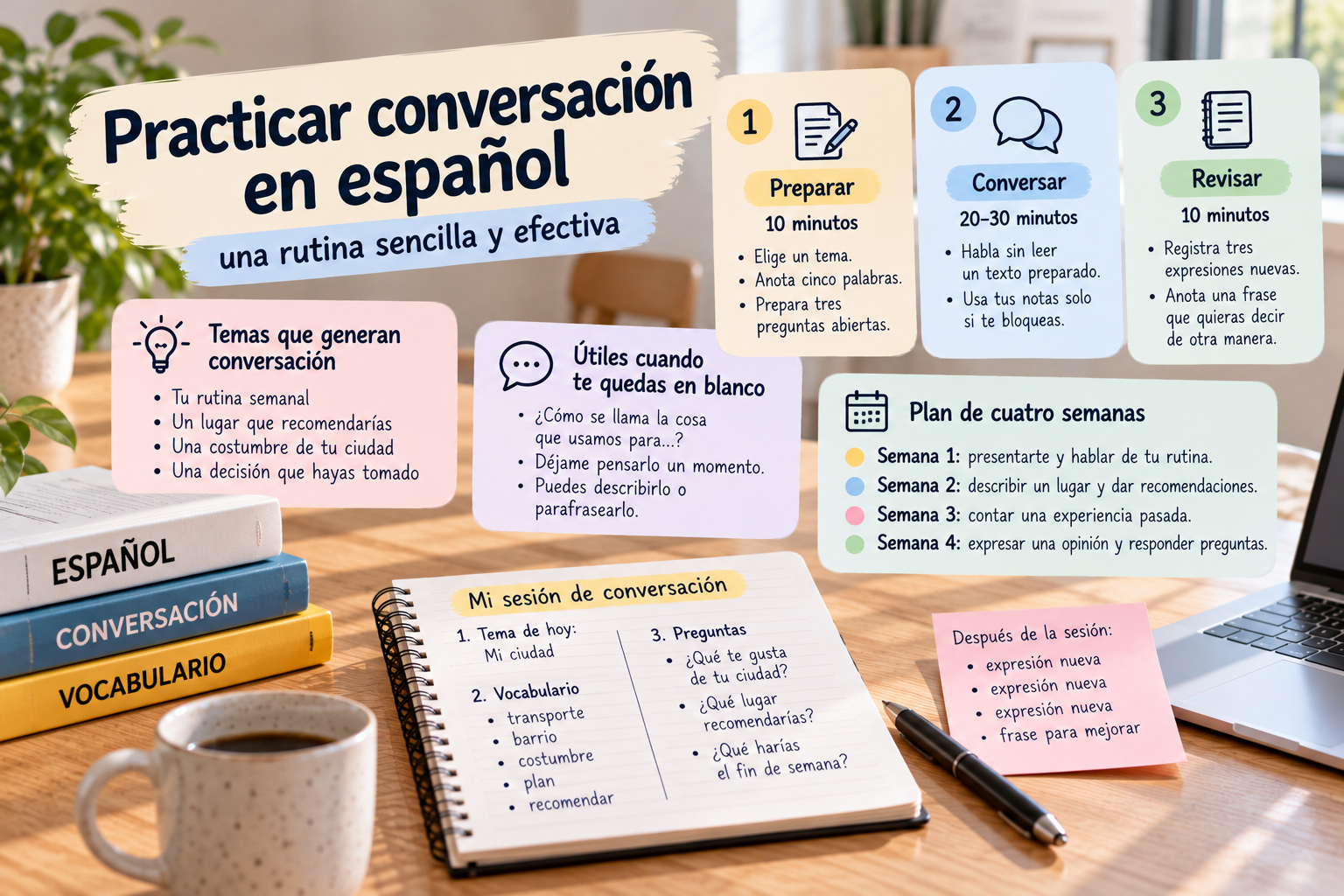
- Prepare, 10 minutes: choose a topic and write down five words and three open-ended questions.
- Talk, 20–30 minutes: speak without reading a prepared text; refer to your notes only if you get stuck.
- Review, 10 minutes: record three expressions you were missing and one sentence you would like to say differently.
If your schedule does not allow three separate sessions, combine preparation and review on the day of your conversation. The important thing is to reuse the new expressions.
Topics that spark conversation
Choose subjects you can explain from experience: how you organise your week, a place you would recommend, a custom from your city or a simple decision you have made. Avoid starting with topics that are too abstract if you lack the vocabulary. Prepare questions such as ¿Qué te sorprendió? (What surprised you?), ¿Qué prefieres? (What do you prefer?) or ¿Qué harías en esa situación? (What would you do in that situation?) to encourage the other person to develop their ideas.
What to do when your mind goes blank
Paraphrase, describe the object or ask for a word: ¿Cómo se llama la cosa que usamos para…? (What do you call the thing we use to…?). You can also buy time with Déjame pensarlo un momento (Let me think for a moment). These strategies keep the conversation going and reveal the vocabulary you need.
A four-week plan
Week 1: introduce yourself and talk about your routine. Week 2: describe a place and give recommendations. Week 3: recount a past experience. Week 4: express an opinion and answer questions. Repeat the same conversation format at the end of the month and compare how much you can say without notes.
Agree on simple rules with your conversation partner
Before starting, agree how long you will speak Spanish, whether you want corrections during or after the conversation, and which topic you will cover. If you alternate languages, reserve similar amounts of speaking time for each. Afterwards, each person shares one expression they learned and one question they want to practise next time. These rules reduce awkwardness and prevent the meeting from becoming an improvised lesson for just one person.
A group class adds more conversation partners and varied topics to your practice. Find out about our group Spanish classes.