Understanding a Spanish conversation when several people are talking is a different skill from listening to one speaker. Voices change, people share references and some replies overlap. To keep up, do not try to reconstruct every word: follow the topic, notice who is responding and ask for clarification when the information matters.
Identify the topic and anchor words
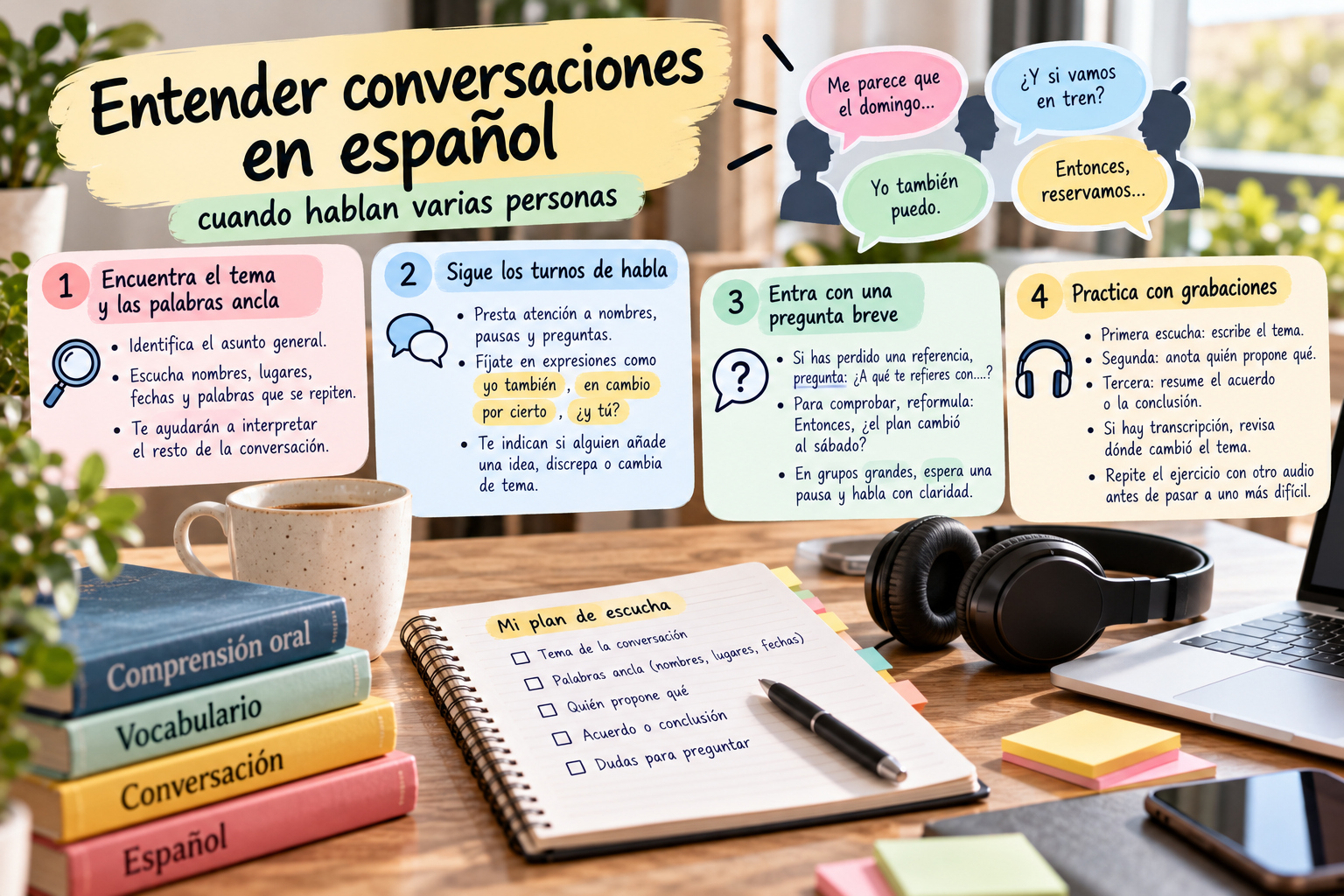
At the beginning, identify the general subject and listen for names, places, dates and repeated words. These act as anchors. If someone is talking about a weekend plan and you hear domingo (Sunday), tren (train) and reserva (booking), you already have clues for understanding the rest even if you miss a sentence.
Follow the speaking turns
Pay attention to names, pauses, questions and expressions such as yo también (me too), en cambio (on the other hand), por cierto (by the way) or ¿y tú? (and you?). These signals show whether someone is adding an idea, disagreeing or changing the subject. Do not worry about following a side conversation that does not affect the main discussion.
Join in with a short question
If you missed a reference, ask ¿A qué te refieres con…? (What do you mean by…?) or ¿Qué pasó después? (What happened next?). To check your understanding, rephrase: Entonces, ¿el plan cambió al sábado? (So, did the plan change to Saturday?). In larger groups, wait for a pause and speak clearly; you do not need to make a long contribution.
Practice with a recording
Choose a conversation with two or three voices. On the first listen, write down the topic; on the second, note who proposes what; on the third, summarise the agreement or conclusion. If there is a transcript, check where the topic changed and which expressions marked the turns. Repeat the exercise with another recording of a similar length before moving on to something harder.
Use context without guessing
How to choose recordings for practice
Look for a conversation where you can identify the number of speakers and the topic, and which is short enough to repeat without getting tired. Start with two people who take turns clearly, then try spontaneous conversations with more participants. Do not increase length, speed and topic complexity all at once. Afterwards, write down who suggested each idea and what decision was made. If you cannot reconstruct the exchange, go back to a shorter section before replaying it all.
Context helps you form a hypothesis, not take it as a certainty. When a detail has consequences—such as a time, address or commitment—confirm it. You can practise with patient conversation partners or in a group suited to your level. Discover our group Spanish classes in Barcelona.