The Spanish subjunctive is not simply the mood of doubt or a list of endings to memorise. It helps express different perspectives on a situation: wishes, evaluations, recommendations, possibilities and other nuances. To start using it, learn common structures first and notice what each speaker is communicating.
Compare the intention, not just the verb form
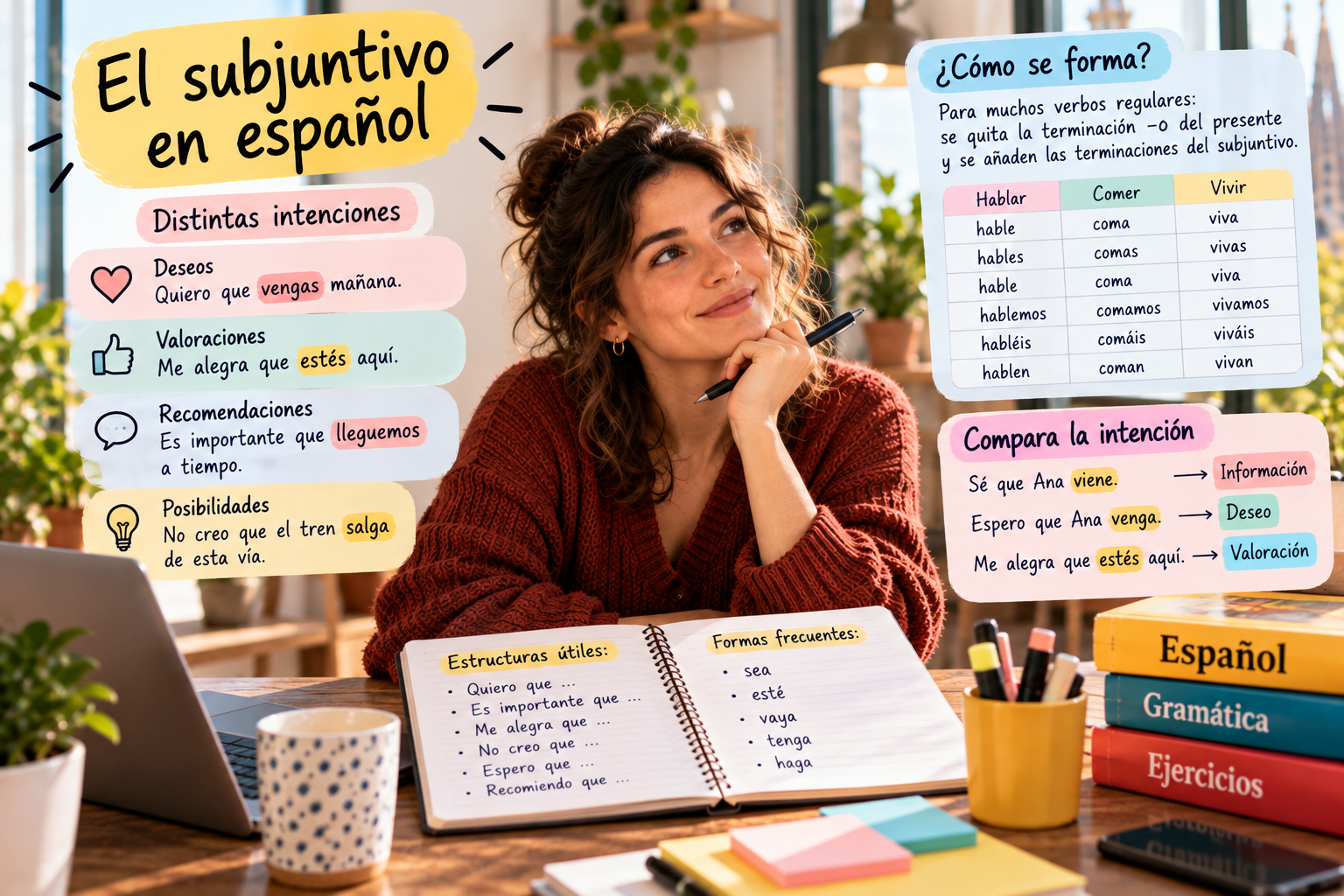
Sé que Ana viene (I know Ana is coming) presents her arrival as information the speaker asserts. Espero que Ana venga (I hope Ana comes) expresses a wish. In Me alegra que estés aquí (I’m glad you’re here), the speaker reacts to a situation. The subjunctive appears in the second part of these structures because of the relationship between the ideas.
Learn sentence frames you can complete
- Quiero que… (I want…): Quiero que vengas mañana. (I want you to come tomorrow.)
- Es importante que… (It’s important that…): Es importante que lleguemos a tiempo. (It’s important for us to arrive on time.)
- Me alegra que… (I’m glad that…): Me alegra que estés mejor. (I’m glad you’re feeling better.)
- No creo que… (I don’t think that…): No creo que el tren salga de esta vía. (I don’t think the train leaves from this platform.)
Practise using real situations from your life and check whether each sentence actually conveys the intended meaning.
A first rule for forming the present subjunctive
For many regular verbs, start with the present-tense yo form, remove the final -o and add the opposite set of endings: hable, hables, hable; coma, comas, coma. There are irregular verbs and spelling changes, so treat this as a starting point and verify new forms.
Exercise: turn an intention into a sentence
Write three wishes for this week, two reactions to something that makes you happy or worried, and one recommendation for a friend. Underline the expression that introduces each idea and the verb that follows. Then change the subject and say the sentences aloud. Review any difficult examples two days later.
Common forms worth recognising
Alongside the regular forms, gradually memorise common irregular ones: sea from ser, esté from estar, vaya from ir, tenga from tener and haga from hacer. Do not study them in isolation: say Espero que vaya bien (I hope it goes well), Quiero que tengas tiempo (I want you to have time) and Me alegra que estés aquí (I’m glad you’re here). Underline the verb form and explain the intention expressed. This helps you remember the conjugation in its actual context.
The subjunctive becomes more familiar when you use it to express something real rather than repeat conjugation tables without context. Practise it in our Spanish courses.