Preparing for an official Catalan exam starts with knowing exactly which test you will take and what tasks it includes. Formats, levels, dates and assessment criteria may vary between examining bodies. Before organising your studies, check the current official notice and sample papers for your specific exam; do not rely only on generic exercises.
Assess your starting point before making a schedule
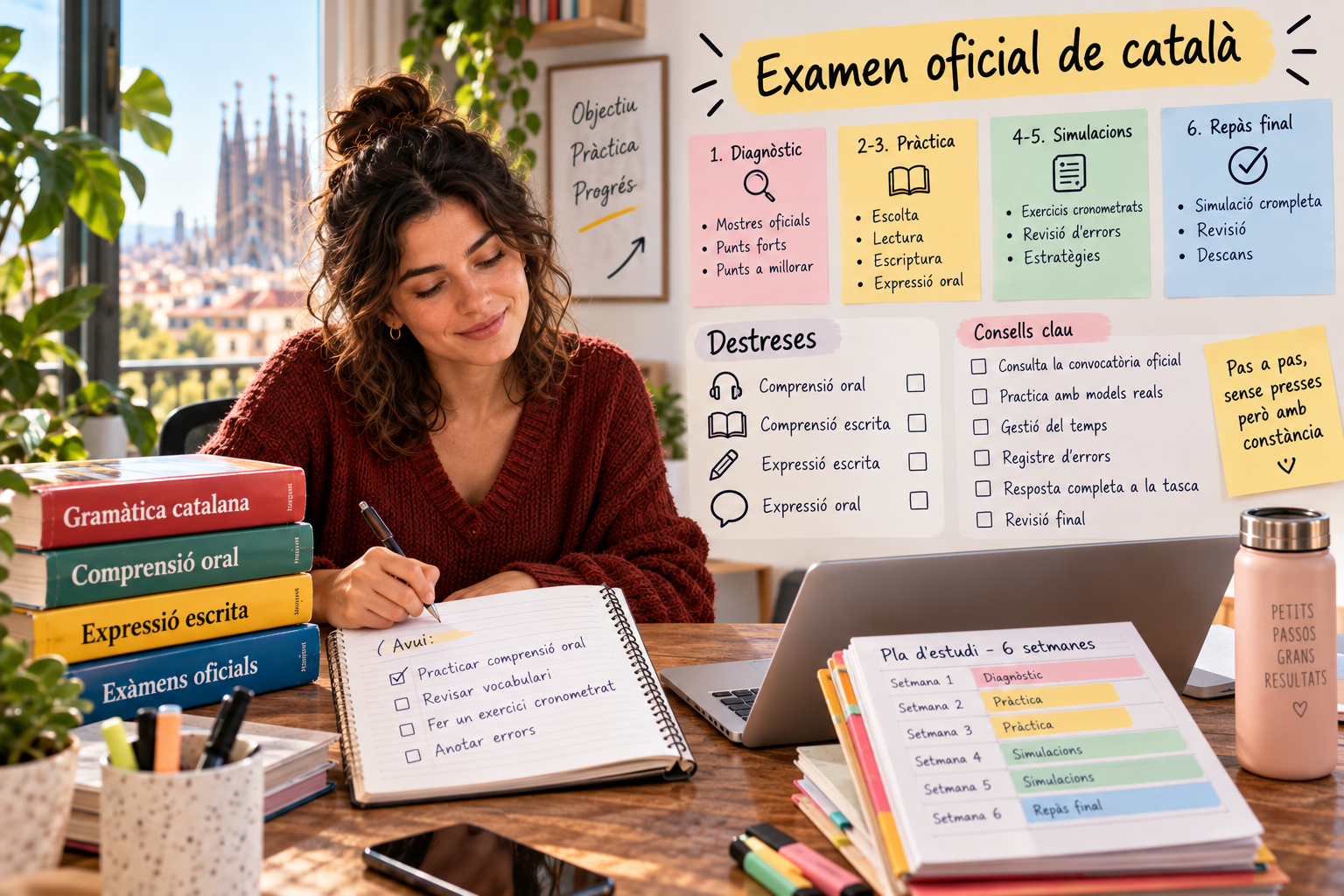
Complete a sample task for each skill assessed: listening, reading, writing and speaking, if applicable. Record your results and difficulties: vocabulary, time management, text structure, pronunciation or understanding instructions. Choose two priorities for the first week instead of trying to fix everything at once.
A six-week preparation plan
- Week 1: initial assessment and reading the official instructions.
- Weeks 2 and 3: short practice sessions focusing on weaker skills, followed by review after each exercise.
- Weeks 4 and 5: timed tasks and partial mock exams.
- Week 6: a complete mock exam, review of recurring errors and some light revision.
Adapt the schedule to the time you have and your current level. Six weeks is an organisational example, not a guarantee of success.
Review your work with an error log
Divide your notes into four columns: sentence or task, what happened, correction or strategy, and review date. If you keep making the same mistake, make up three examples of your own and test yourself again a few days later. For written work, first check that you have answered the task; then review structure, linking words and language accuracy.
Practise under exam conditions
Read the official information carefully to find out how much time you have, which materials are permitted and how the parts are organised. Do some timed exercises to learn to leave time for checking your work. Do not try to make up for weeks of study on the evening before the test: prepare what you need and get some rest.
A short checklist for reviewing your writing
After every task, check each point separately: have I answered everything, does my text have an introduction, development and conclusion, are the paragraphs connected, have I used the right register, and which three mistakes recur? Correct task completion and organisation first, then grammar and spelling. Making every sentence more complex may introduce mistakes that were not there before. Keep your first and corrected versions to see which kinds of revisions help you most.
Individual guidance can help you set priorities and review your work. Explore our Catalan courses.