If you already speak Spanish, learning Catalan in Barcelona offers a real advantage: you already know many similar structures and words. But similarity can be misleading. Literal translations and assumptions that two expressions work in the same way can create habits that are hard to correct. The best strategy is to make the most of what is similar and consciously study what differs.
Start with a listening comprehension test
Listen to a short Catalan recording on a familiar subject. On the first listen, note only the main topic and who is speaking. On the second, record three details. Then consult the transcript or a dictionary to identify what helped you: similar vocabulary, context or a new word. This exercise builds on your Spanish without requiring you to understand every sentence.
Watch out for common interference from Spanish
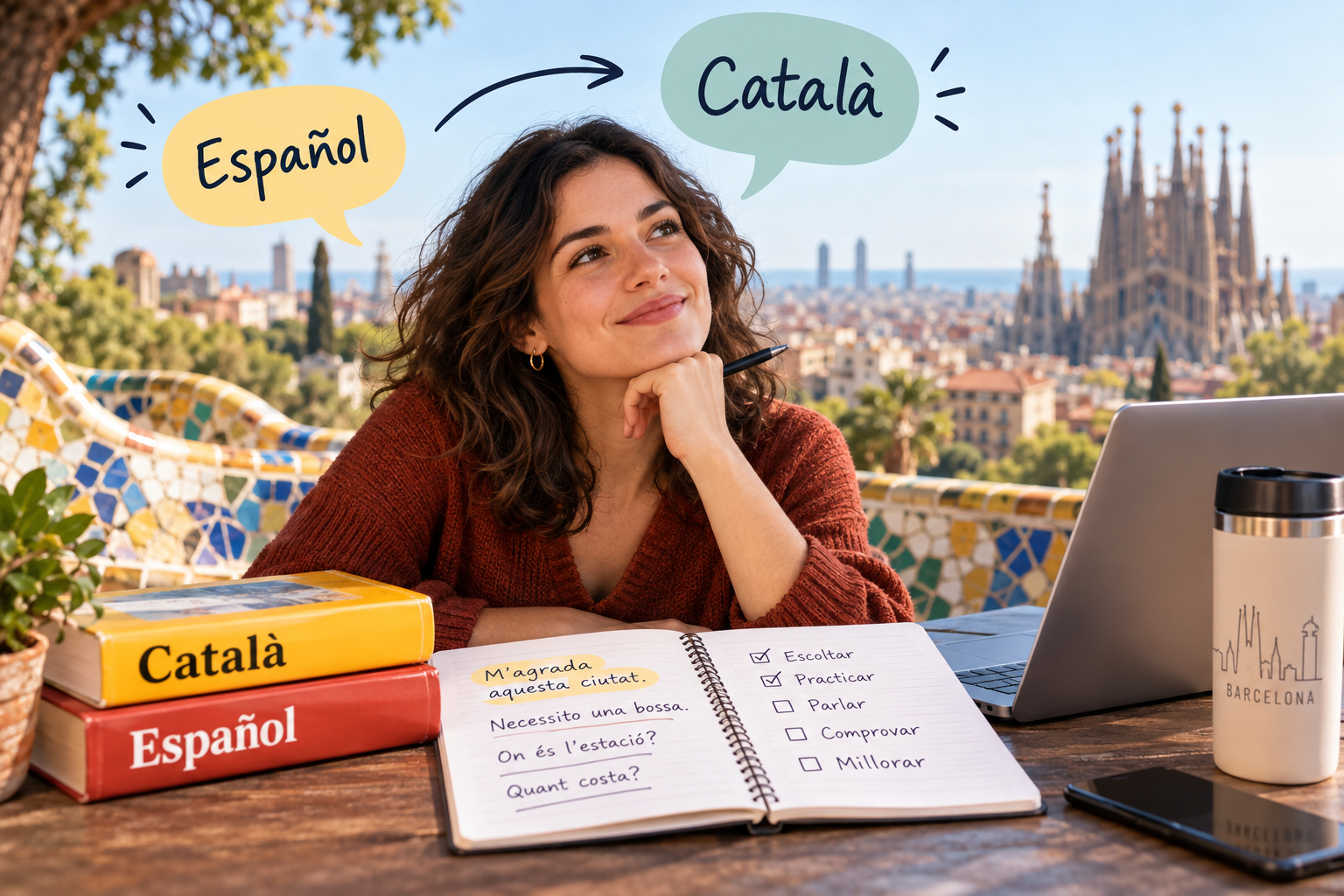
A similar word is not always combined in the same way. Pay attention to articles, prepositions, weak pronouns and verb forms. For example, learn m’agrada (I like) within sentences such as M’agrada aquesta ciutat (I like this city), instead of translating each word separately. Keep a personal list of recurring mistakes: when you use a phrase copied from Spanish, write the Catalan form you have heard beside it, along with an example of your own.
Turn vocabulary into sentences you can recall
Choose an everyday topic—shopping, transport or work—and learn five complete expressions. Read them, cover them and try to reconstruct them. Then change one part: Necessito una bossa (I need a bag), Necessito una cita (I need an appointment). This way you practise vocabulary and sentence structure together.
A four-week routine
- Week 1: greetings, introductions and sounds.
- Week 2: questions for shopping, asking directions and requesting clarification.
- Week 3: two-minute conversations about your routine.
- Week 4: record yourself again on the same subject and compare what you understand and can express.
A checklist to track progress
At the end of each week, check whether you can do three things without reading: introduce yourself for a minute, ask a question to handle an everyday situation and understand the main idea of a short recording. Note which expression you lacked and practise it again in a new sentence. If you only recognise a word when you see it written down, you still need to work on its spoken form. This self-assessment distinguishes understanding, recall and production, giving you a clear next step instead of a vague feeling that your language skills are or are not improving.
You do not need to stop using Spanish: set aside specific times for Catalan practice and ask for corrections on just one or two aspects at a time. For a learning sequence adapted to your level, explore our Catalan courses in Barcelona.