To choose between ser and estar in Spanish, think about what you want to communicate and how you present the information. The rule “ser is permanent and estar is temporary” can be a starting point, but it does not explain many uses: Madrid está en España (Madrid is in Spain) describes a non-temporary location; La reunión es en la sala 3 (The meeting is in room 3) refers to an event and uses ser.
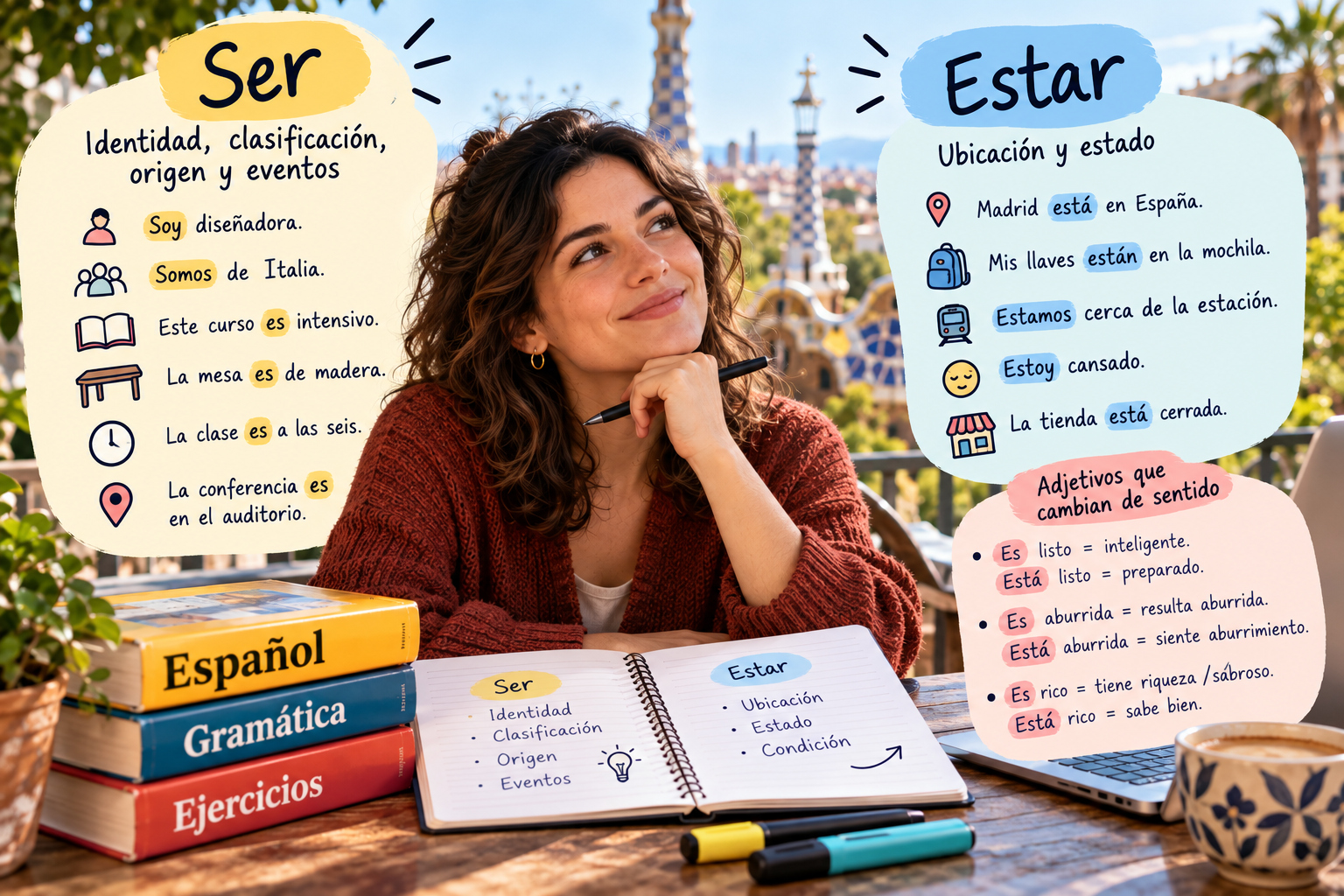
Ser: identity, classification, origin and events
We use ser to identify or classify: Soy diseñadora (I’m a designer), Este curso es intensivo (This is an intensive course). It also expresses origin and material: Somos de Italia (We’re from Italy), La mesa es de madera (The table is made of wood), as well as time or date: La clase es a las seis (The class is at six). Locations of events usually take ser: La conferencia es en el auditorio (The conference is in the auditorium).
Estar: location and state
Estar locates people and objects: Mis llaves están en la mochila (My keys are in my backpack), Estamos cerca de la estación (We’re near the station). It also describes states or conditions: Estoy cansado (I’m tired), La tienda está cerrada (The shop is closed). The verb does not imply the state will be short-lived; it describes how or where something is.
Adjectives that change meaning
- Es listo: he is clever. Está listo: he is ready.
- Es aburrida: she or the activity is boring. Está aburrida: she feels bored.
- Es rico: he is wealthy or, depending on context, it is tasty. Está rico: the food tastes good.
Context helps you understand which meaning is intended.
How to practise without memorising an endless list
Describe a room using estar for locations and an object using ser for its material; then explain how you feel today and what you do for a living. If you hesitate, first ask whether you are identifying or classifying something, locating it, or describing its state. Write paired examples for adjectives whose meaning changes.
Common mistakes to avoid
Do not choose the verb solely according to how long something will last: Está muerto (he is dead) and Está casada (she is married) may describe long-lasting conditions. Nor should you always use ser with adjectives about people: está cansada describes her state even if nobody says how long it will last. Ask what information your sentence conveys, and look at complete examples in the same context.
Correction during conversation helps you connect each choice with a specific meaning. Practise in our Spanish courses.