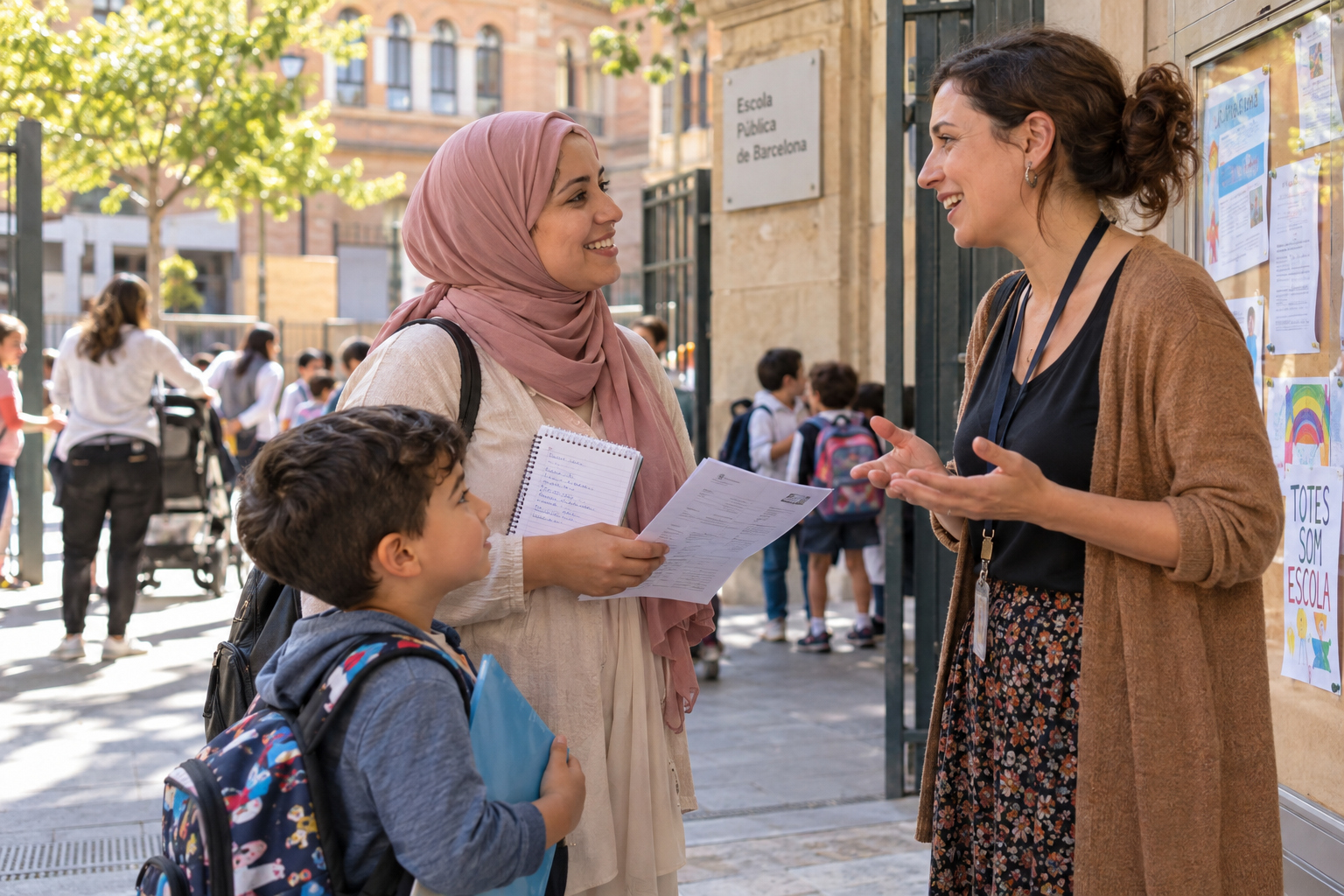
Catalan for newly arrived families is useful in specific situations: understanding a notice, asking about a meeting, discussing timetables or getting to know other families. Learning phrases for these situations makes communication easier even before you reach an advanced level. This guide offers general language tools; always confirm specific timetables and requirements with the school concerned.
Useful phrases for talking to the school
- Quan és la reunió?: when is the meeting?
- Què ha de portar demà?: what does my child need to bring tomorrow?
- Em podeu explicar aquest avís?: could you explain this notice to me?
- Com puc contactar amb la tutora?: how can I contact the class teacher?
- No he entès l’última part. M’ho podeu repetir?: I didn’t understand the last part. Could you repeat it?
Prepare for a short conversation
Before a meeting, write down three things: what you want to know, what information you need to share, and what you will ask if you do not understand a reply. Bring a note with names and dates. During the conversation, repeat important information to confirm it: Per tant, la sortida és a les quatre, oi? (So, the outing is at four, right?).
Build vocabulary around your family routine
Group words into timetables, activities, school supplies, meals and communication. Add a real-life example for every term. Rather than memorising a long list, learn the words you need this week and reuse them in sentences.
Practise as a pair or family
Role-play a situation for five minutes: asking for information, reporting an absence or asking about an activity. One person plays the other speaker while the second practises, then swap roles. Children can learn through games, but should not be expected to translate or correct the adults.
A short message requesting information
You can adapt this model: Bon dia, soc el pare/la mare de [nom]. Us escric perquè voldria confirmar [pregunta concreta]. He entès que [informació que has rebut], és correcte? Moltes gràcies. (Good morning, I am [name]’s father/mother. I’m writing to confirm [specific question]. I understood that [information received]; is that correct? Thank you.) Replace the information in square brackets with your actual situation, and check names and dates before sending. The message provides context, asks a specific question and makes it easier to give a clear answer. Do not include unnecessary personal data in messages shared with other families.
Practice should be adapted to each family’s ages, schedule and language experience. Discover our Catalan courses in Barcelona.