Asking someone to repeat something in Spanish is not an inappropriate interruption; it is a strategy for understanding and staying involved. Pretending you have understood may cause you to miss even more information. Knowing several ready-made phrases lets you ask for the help you actually need: a repetition, the meaning of a word, or a slower pace.
Choose a phrase according to what you missed
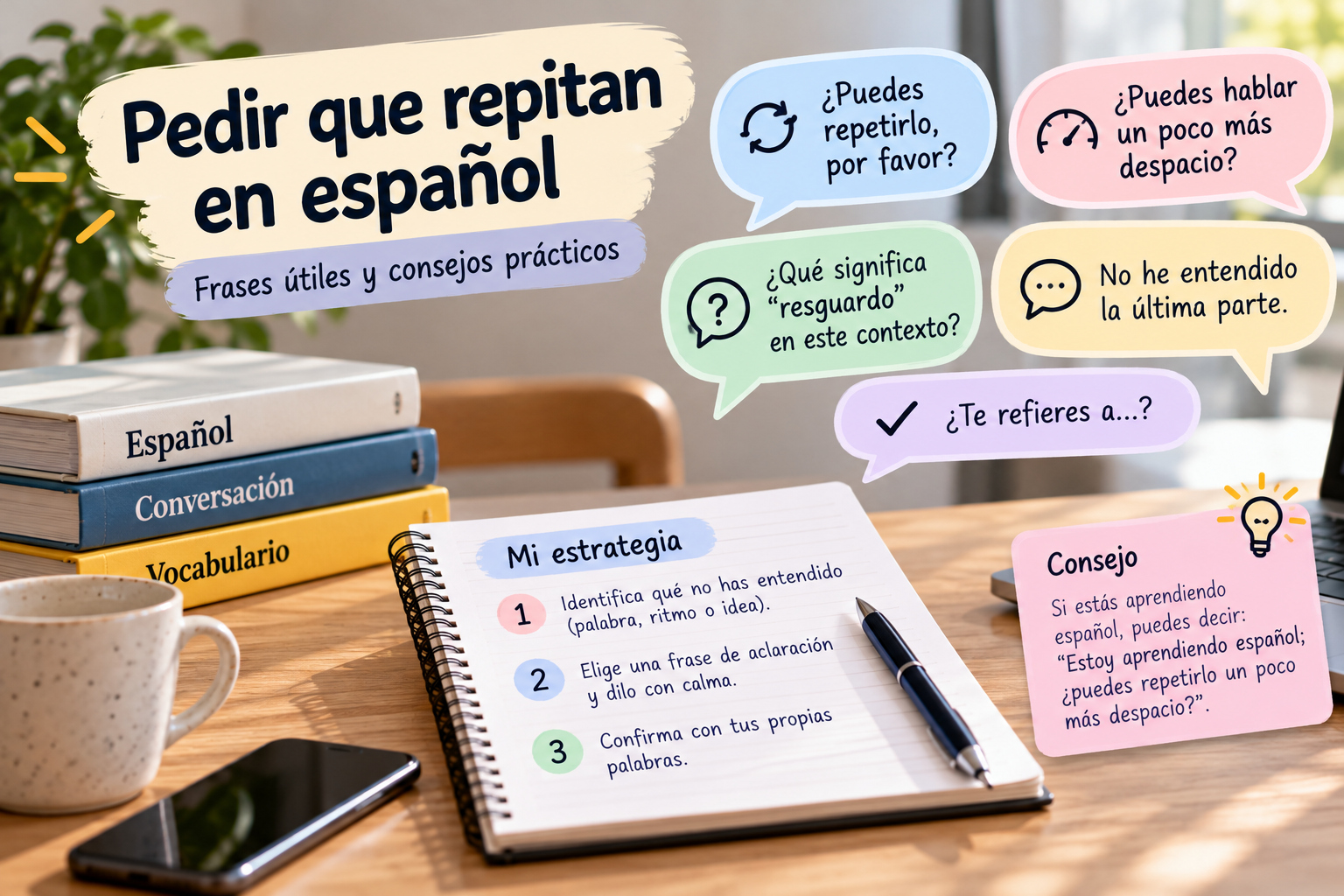
- ¿Puedes repetirlo, por favor? (Could you repeat that, please?): when you need to hear the entire sentence again.
- ¿Puedes hablar un poco más despacio? (Could you speak a little more slowly?): when you understand the words, but not at that speed.
- ¿Qué significa… en este contexto? (What does… mean in this context?): when a particular word is stopping you.
- No he entendido la última parte (I didn’t understand the last part): when you only need to hear the ending again.
- ¿Te refieres a…? (Do you mean…?): to check your interpretation.
In formal situations, replace puedes with puede and use ¿Podría repetirlo, por favor? (Could you repeat that, please?).
How to confirm without repeating the whole conversation
Turn the main information into a question: Entonces, ¿nos vemos en la entrada a las siete? (So, shall we meet at the entrance at seven?) or ¿El documento se envía por correo electrónico? (Is the document sent by email?). The other person can confirm or correct the detail, and you make sure you have understood each other.
Practise a three-step approach
- Identify what you missed: a word, the pace, or a whole idea.
- Choose a clarification phrase and say it calmly.
- Repeat the information you understood in your own words.
Rehearse this approach with audio recordings: pause the recording once, say aloud the question you would ask and then keep listening. This also trains you to rejoin the conversation.
If you feel embarrassed about asking
Briefly explain that you are learning: Estoy aprendiendo español; ¿puedes repetirlo un poco más despacio? (I’m learning Spanish; could you repeat that a little more slowly?). You do not need to apologise repeatedly. Speaking is a shared activity, and asking for clarification helps the exchange move forward.
When you understand the sentence but not one word
Instead of asking for the entire sentence again, point to the part you missed: ¿Qué significa “resguardo” aquí? (What does “resguardo” mean here?) or He entendido que es el jueves, pero no el lugar (I understood it is on Thursday, but not where). If a word has several meanings, ask for an example sentence. To remember the explanation, use it immediately in your own sentence. The conversation can continue as you learn; you do not need to stop and look up every unfamiliar word.
Practise these situations in guided conversations in our Spanish courses.